

Blog
Why Calle del Pez in Malasaña is called that
Learn the story behind Calle del Pez in Malasaña: its name, the stone fish, Blanca Coronel, and its place on the Texeira map of Madrid.
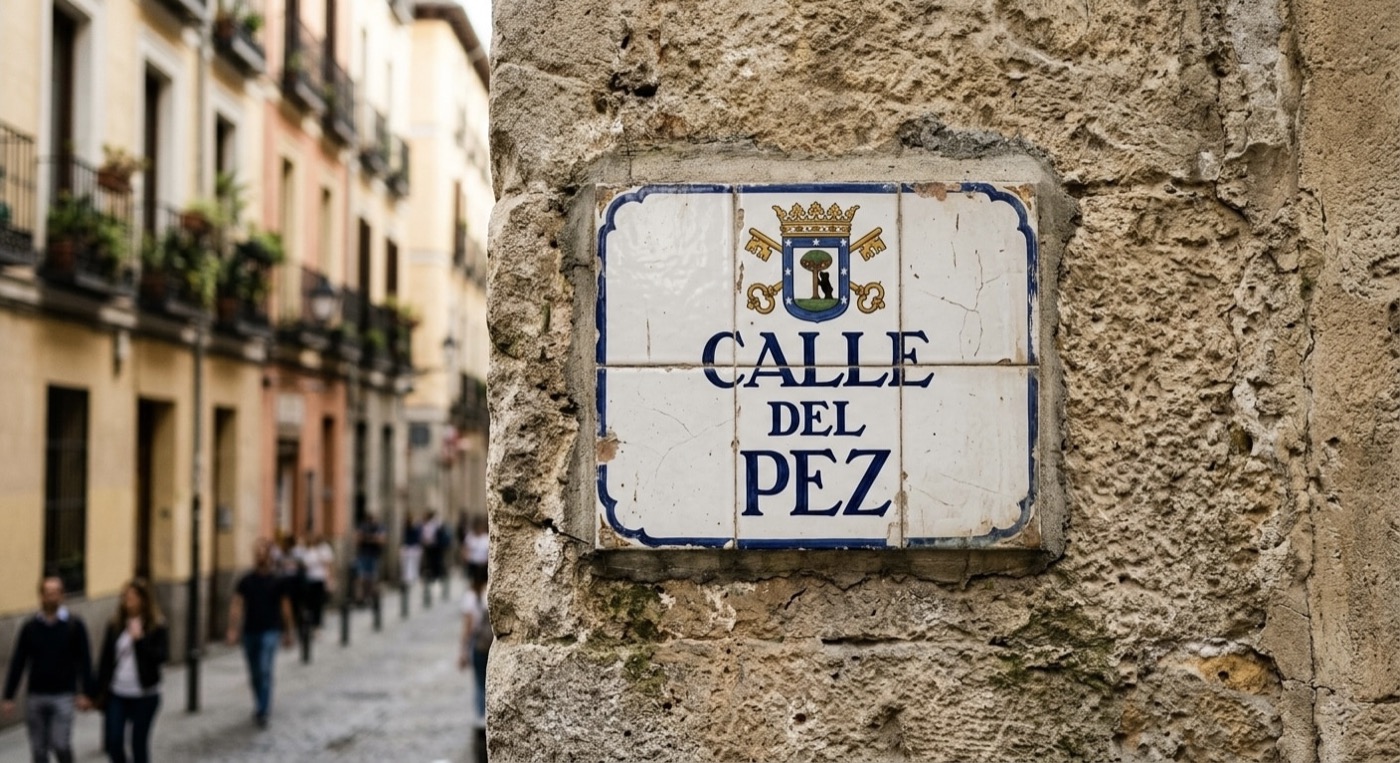
In Malasaña, there are streets you walk down and streets you decode. Calle del Pez is one of the latter: short, central, running between Corredera Baja de San Pablo and San Bernardo, but with a history good enough to have lasted centuries and still pop up in local conversations.
If you like your Madrid layered (neighbourhoods, history, culture, and meaningful walks), at Adventure Hostel Madrid we give you the base and the mental map: what you see and what it means.
Where Calle del Pez is and why it’s “very Malasaña”
Calle del Pez is in the Universidad (Malasaña) neighbourhood and connects two lively axes: Corredera Baja de San Pablo and San Bernardo. It’s a relatively short street (around 400 metres), but it has that typical Malasaña density: theatres, shops, historic bars, and a “walkable city” vibe that sneaks up on you.
The interesting thing here is that its name doesn’t come from an epic statue or a solemn politician. It comes—as often happens in Madrid—from an anecdote that became a sign, then a habit, and finally just “that’s what it’s called, full stop.”
Why it’s called Calle del Pez: the “Fuente del Cura,” a pond… and a girl
The most repeated (and most charming) explanation starts with a prior fact: for a long time, this street wasn’t “del Pez.” It was known as Calle de la Fuente del Cura because the area had an estate with five ponds and a fountain of “very fine waters,” owned by Don Diego Henríquez, a clergyman of noble lineage.
When Philip II moved the Court to Madrid, the city bought part of these lands to build housing. Another part was acquired by Juan Coronel, and the old pond ended up on his property. Some fish lived there… until the water began to dry up due to the construction work.
Here’s the scene that changes everything: Blanca Coronel, the owner’s daughter, saved the last little fish, kept it in a glass bowl, but it died a few days later. To console her, her father had a stone fish carved on the facade of the house and placed a sign: “Casa del Pez” (House of the Fish). The street eventually inherited the name.
And the best part (because that’s Madrid): although that house was replaced over time, the tradition continued, and a similar symbol was placed on a later facade. In other words, the fish isn’t just a story; it’s an urban detail the neighbourhood has chosen to keep as its signature.
A very Madrid-style twist: Blanca Coronel is said to have felt drawn to monastic life and became one of the first professed nuns at the Convento de San Plácido (another spot full of stories and legends in the city centre).
Legend or history? The definitive clue is in the maps
Madrid has an unwritten rule: often the legend comes before the paperwork… but the paperwork eventually shows up.
In the case of Calle del Pez, there’s a very strong historical anchor: the map by Pedro Texeira (1656), one of the great cartographic portraits of 17th-century Madrid, preserved and promoted by the city’s cultural institutions.
This map (and the studies around it) help clarify something key: the area was already perfectly identified in Baroque Madrid. The fact that the street is called “del Pez” isn’t a recent trend or a contemporary Malasaña invention; it’s a name that solidified over time, driven by a popular story the neighbourhood adopted as part of its identity.
Curiosities that explain the street’s character
A theatre named after the street
Calle del Pez has a very specific cultural point: Teatro Alfil, at no. 10. It’s one of those places that sums up the neighbourhood: performances, nightlife, and an entrance that, many evenings, feels like Malasaña’s “corridor” to the plan.
A street with “neighbourhood pride” (and even a slogan)
Time Out notes a very local curiosity: in the 1970s, shopkeepers and residents launched a radio campaign to defend the area from deterioration and certain urban planning proposals. From this came a slogan that feels very Malasaña: “Quien compra en la calle Pez, bien sabe lo que pesca” (Those who shop on Calle del Pez know what they’re catching).
Yes, it also has “street parties”
Another quirky detail: the street itself hosts celebrations associated with San Antonio in early June, organised by locals with outdoor activities (workshops, open mic, concerts…). It’s not “Madrid’s big festival,” but it’s a perfect thermometer for what makes this neighbourhood special: community and the street.
Fancy a Madrid you explore calmly and with context (not a “checklist”)? Stay at Adventure and we’ll give you neighbourhood routes like this one, with history and stops that are worth it.
Blog
Sigue leyendo
Madrid con bajo presupuesto: cómo disfrutar la ciudad sin gastar de más
Descubre cómo disfrutar Madrid con bajo presupuesto: alojamiento, planes gratis y dónde comer barato. Consejos prácticos desde el centro de Malasaña.
Aviso amarillo en Madrid: la AEMET activa la alerta por temperaturas de hasta 38º
La AEMET activa el aviso amarillo en Madrid por temperaturas que alcanzarán los 38º. Consejos, planes y cómo moverse desde Malasaña.
Dónde dormir en Malasaña: opciones para todos los presupuestos
Descubre dónde dormir en Malasaña, desde opciones cómodas y accesibles como Adventure Hostel Madrid hasta todo lo que el barrio ofrece a pie de calle.