

Blog
Madrid Book Fair 2026: Dates, Theme and Highlights
Visit Madrid Book Fair 2026 (29 May–14 June) in El Retiro. Explore its humour theme, history since 1933, and iconic literary spots like Moyano.
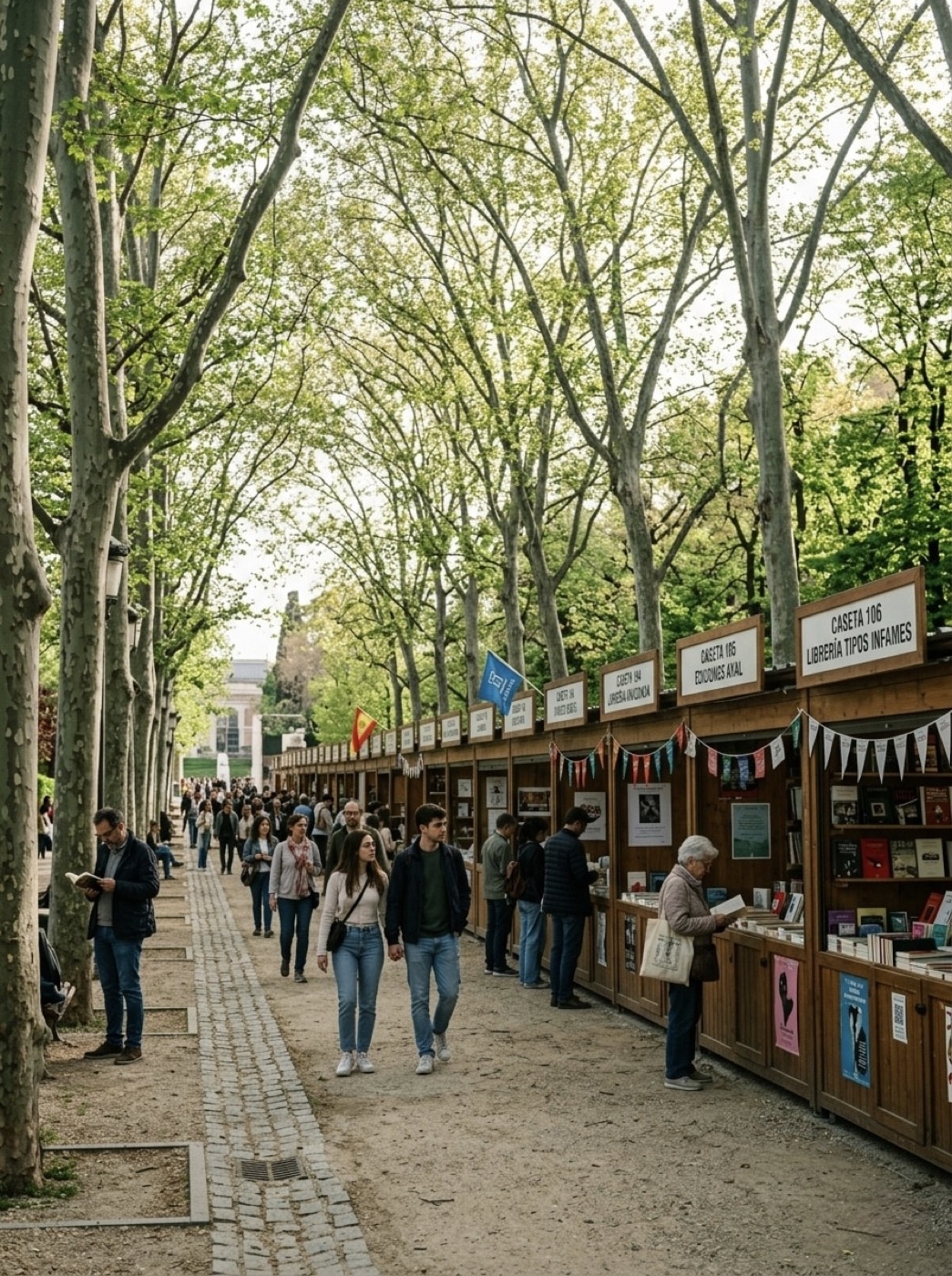
There are moments when Madrid feels like a city, and then suddenly, it turns into an open-air library. This happens every year with the arrival of the Book Fair: El Retiro fills with bookstalls, hushed conversations, paper bags, newly discovered covers, and that slow-paced feeling that only comes when a cultural plan blends with a park, light and shade.
In 2026, the Madrid Book Fair celebrates its 85th edition, from 29 May to 14 June, in El Retiro Park. This year, it does so with a very Madrilenian theme at its core: humour (not as a 'genre' but as a way of understanding the world).
If you're coming to Madrid for culture — museums, walks, bookshops, and soulful plans — Adventure Hostel Madrid can be your base: a neighbourhood vibe, calm, real recommendations, and that sense of community that turns a trip into a story.
Madrid Book Fair 2026: What’s New This Year
First things first: dates and location. The organisers have confirmed that the 85th edition will take place from 29 May to 14 June 2026 in El Retiro. And while the fair always has a sense of 'tradition returning', this year there are clear signs of how it’s evolving.
The most visible change is the theme: humour as the focus for 2026. The Fair itself presents it as a way of reading (and living) that can serve as refuge, critique, and a way of telling our story. In line with this, the illustrator Miguel Pang is the poster artist for this edition, with the official image set to be unveiled in early April.
Internally, the fair also shows its structure: in 2026, 366 'inline' bookstalls have been allocated (plus those for trade groups/associations), and two specific zones for small publishers have been added. This is a significant clue about the event's direction: editorial diversity and space for smaller projects, which often deliver the most surprises. The allocation of stalls also points to a broader territorial presence with the inclusion of new publishers’ associations (more of 'reading Spain' coming to Madrid for over two weeks).
And here’s a practical but culturally significant tip: during the fair, a 10% discount is applied to the retail price (PVP) for books sold within the venue (no additional discounts allowed). It’s not just about 'price'; it’s part of the fair ritual — the little nudge to finally pick up that title you’ve been postponing.
Finally, design matters more than it seems. This year, the Fair is awarding the 2026 Loyalty Prize to Pep Carrió for his contribution to the event’s visual identity. The prize ceremony will take place on 29 May, before the inaugural talk. It’s a reminder that the walking experience — signage, readability, the sense of 'this flows' — is also carefully designed.
How to Get There (Without the Hassle)
The Fair recommends using public transport. By metro, the most common stations for entering El Retiro and exploring on foot are: Estación del Arte (L1), Ibiza (L9), Príncipe de Vergara (L2/L9), and Retiro (L2).
A Fair That Explains a City
What draws people to the Madrid Book Fair isn’t just 'buying books'. It’s that, for a few days, Madrid changes its rhythm: conversations slow down, people take their time to browse, and the park becomes a narrative walk where each stall competes to entice you with a cover, a title, or a recommendation from someone who knows the book inside out.
There’s something very Madrilenian about the city’s major literary event being a park plan: not a red carpet, but a pathway. El Retiro turns culture into something physical: you walk, you stop, you sit, you get up again. And in that simple movement, something special happens: the fair brings together readers who would never otherwise meet, giant publishers with tiny imprints, classics with new releases, the curious with collectors. The organisers themselves emphasise the idea of the fair as a space for meeting and sharing different perspectives, and in 2026, they connect this to humour as a form of resistance and a way of reading the present.
The fair also has a unique quality: it’s massive, yes, but also intimate. You can go with friends, as a couple, or alone, and it works in all cases because books act as a bridge. If you go alone, you’re not 'alone': you’re accompanied by a thread of conversations, spontaneous recommendations, and the feeling of being part of a city that, for a few days, recognises itself as a community of readers.
History: From Recoletos to El Retiro (and How It Became a Tradition)
The Madrid Book Fair didn’t start in El Retiro. The first edition was organised in 1933 as part of Cervantes Week, from 23 to 29 April, and was held on Paseo de Recoletos. This detail is important because it explains the fair’s DNA: Madrid already understood books as a public, street-level, shared event.
And there’s a lovely scene from that first fair: the stalls were painted in different colours and had loudspeakers on top. Not just for official speeches, but so writers of the time could speak during the week through a microphone placed in front of the Church of San Pascual. In other words: books as objects... and books as public conversation.
Over time, the fair grew and became what you now recognise as soon as you set foot on the bookstalls’ promenade. A key milestone: the move to El Retiro Park in 1967. Another: since 1982, it has been organised by the Madrid Booksellers Association, in collaboration with publishers and distributors, which also explains the balance (sometimes tense, sometimes brilliant) between industry, culture, and city.
Madrid has many traditions, but few as consistent with its personality as this one: a capital that prides itself on its museums and theatre, yes, but also has the feel of a big neighbourhood where important things are discussed while walking. The fair is exactly that: culture on foot.
Curiosities with a Madrilenian Flavour (and Why They Change How You See the Fair)
Humour as a Theme Isn’t 'Light': It’s a Statement
The fact that 2026 is dedicated to humour isn’t an aesthetic whim. The Fair itself presents it as a way of thinking: laughing to survive, to critique, to tell stories that don’t fit into solemn narratives. If you keep this in mind, the fair becomes a game: you start spotting irony, graphic humour, satire, sharp storytelling, and books that make you smile while tackling serious topics.
Design Is Part of the Walk (and That’s Why It’s Rewarded)
Many people don’t think about it, but the comfort of a fair is also built through visual identity: signs, maps, readability, order. The 2026 Loyalty Prize to Pep Carrió highlights this, and the fact that the prize is awarded at the start of the fair (29 May, before the inaugural talk) underscores its importance: the visitor’s experience matters too.
366 Stalls and Still Space for the Small
In a large fair, it’s easy for independent publishers to get lost. That’s why it’s significant that the organisers have planned two specific zones for small publishers, in addition to the 366 inline stalls. It’s one of those decisions that readers appreciate: it increases the chances of finding that book you won’t see in every shop window.
The 'Official' Discount Is Also Part of the Sector’s History
The 10% discount on PVP during the fair isn’t a 'commercial detail'; it’s part of how the event is structured and its internal rules (and, incidentally, a tradition: the fair as an opportunity for cultural purchases). The 2026 regulations explicitly state this for sales within the venue to final buyers and prohibit additional discounts.
Madrid Around the Fair: Two Literary Stops with Their Own Stories
If you want the Book Fair to be more than an isolated chapter and instead a thread that weaves your trip together, Madrid makes it easy. Here are two places that work as perfect 'prologues'.
Cuesta de Moyano: The Book Market Madrid Just Declared Heritage
A stone’s throw from El Retiro, next to the Botanic Garden, the Cuesta de Moyano is one of those places that looks like a postcard... until you experience it. In January 2026, the Community of Madrid issued Decree 2/2026 (14 January), declaring the Cuesta de Moyano Book Fair an Asset of Cultural Interest in Intangible Heritage.
The decree itself highlights something essential: Moyano has been part of Madrid’s cultural heritage since 1925 and describes its identity as a permanent fair for old and second-hand books. Among its curiosities, the text includes a gem: in the 1920s, Ramón Gómez de la Serna noted that the price of a boquerón (anchovy) and a second-hand book coincided (fifteen céntimos) and started calling it 'the anchovy fair'.
Visiting Moyano after the Book Fair makes sense: you go from the new to the found. From the shiny to the lived-in. It’s the contrast that makes Madrid what it is.
Eugenio Trías Library: Reading Inside El Retiro (Where the Park Turns Silent)
Within El Retiro itself is the Eugenio Trías Municipal Public Library (Casa de Fieras). It’s the perfect spot if you want your literary plan to include a moment of quiet: sit down, open what you’ve just bought, and read at your own pace. The official schedule lists long opening hours (and specifies the summer timetable change).
What’s special here is the scene: you leave the fair (noise, stimulation, covers), walk a few metres, and enter a space where everything quietens down. It’s Madrid reminding you that literature isn’t just about buying; it’s about staying.
Living the Fair the Way Madrid Lives
The Madrid Book Fair is an event, yes, but above all, it’s a way of walking the city: from its history (Recoletos, 1933) to its present (Retiro, 85th edition, humour as a theme), through the network of bookshops, parallel fairs, and reading rituals that Madrid protects, even as heritage, as with the Cuesta de Moyano.
And that’s the trick: not coming 'to see bookstalls', but coming to feel Madrid in culture mode. A book as a souvenir, yes. But also a walk, a conversation, an afternoon in the park, and a city that — for a few days — reads itself out loud.
If your trip to Madrid coincides with the fair, make it complete: stay somewhere where culture isn’t a slogan but a plan that comes naturally.
Blog
Sigue leyendo
Madrid con bajo presupuesto: cómo disfrutar la ciudad sin gastar de más
Descubre cómo disfrutar Madrid con bajo presupuesto: alojamiento, planes gratis y dónde comer barato. Consejos prácticos desde el centro de Malasaña.
Aviso amarillo en Madrid: la AEMET activa la alerta por temperaturas de hasta 38º
La AEMET activa el aviso amarillo en Madrid por temperaturas que alcanzarán los 38º. Consejos, planes y cómo moverse desde Malasaña.
Dónde dormir en Malasaña: opciones para todos los presupuestos
Descubre dónde dormir en Malasaña, desde opciones cómodas y accesibles como Adventure Hostel Madrid hasta todo lo que el barrio ofrece a pie de calle.